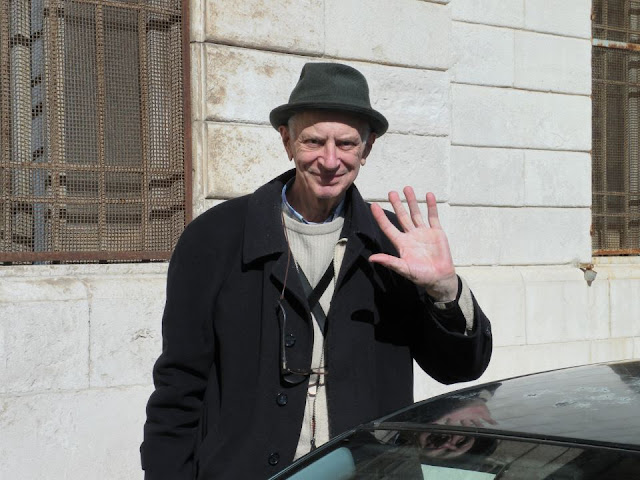
"If the Flesh is Sad, What Remains of Books?" by Carlo Coppola

This morning, February 17, 2026, Anna Hakobyan and Armenian Prime Minister Nikol Pashinyan officially registered their marriage. A civil act, but also a public gesture that intertwines private life and institutional responsibility. The date thus takes on symbolic significance, inviting a fresh reading of the cultural initiative bearing Hakobyan's signature: "Learning is Trendy" — a campaign promoted through the My Step Foundation to bring young people closer to reading, through events held across the country and conceived along a dialogic, almost TED-style model.
The idea is as ambitious as it is simple: to make the book a collective reference point, reclaiming it from its purely academic dimension and restoring it as a living, shared, even desirable practice. In an age dominated by digital fragmentation, the campaign presents the book as a space for concentration and depth — a place where thought is not immediately consumable but built over time. Not an object to accumulate, but an experience to move through.
And yet, as Stéphane Mallarmé wrote in the most enigmatic line of Brise Marine:
La chair est triste, hélas! et j'ai lu tous les livres. ("The flesh is sad, alas, and I have read all the books.")
Reading, then, is neither intellectual nostalgia nor simple refuge — it is also a warning. To have read everything, or to believe one has, does not fill the void of existence if one remains on the surface. Mallarmé stages the saturation of knowledge: accumulation does not save, erudition does not console. When reading becomes cultural consumption, an identity ornament, a status to display, it leaves the reader hungrier for meaning, exposed to an even subtler form of solitude.
One must move through the text, not merely possess it. The book must read us.
Here, almost in counterpoint, enters the visionary Carmelo Bene, whose experimental novel Our Lady of the Turks pushes this intuition to its extreme. Where Mallarmé warns against the illusion of having read enough, Bene denies the reader any such illusion in the first place: his is a text that does not accompany but disorients, that challenges and dismantles linguistic certainties, constantly reshaping its own narrative and summoning theater, music, mysticism, and philosophy into its orbit. Great literature does not meet expectations — it redefines them. It does not reassure; it destabilizes.
To read, in this sense, is a necessary risk: it means opening a productive wound in the meaning we already hold, accepting that the text can fracture our inner grammar.
Viewed against this tension, "Learning is Trendy" appears less as a promotional operation and more as an attempt to reintroduce a powerful idea of culture. The goal is not to multiply events, but to rebuild an interior habit. In a society marked by deep political and identity-related transformations, contemporary Armenia is called to rethink its relationship with memory, with its diaspora, with its language. The book becomes, in this light, a space for symbolic recomposition.
The registration of the marriage between Hakobyan and Pashinyan can also be read, within this framework, as a gesture of formalization: putting into writing what already existed, giving legal form to a lived reality. Reading, too, is a way of formalizing experience — it names the world, articulates it, makes it thinkable. But for this to happen, the book must be not merely an object, but an event.
Mallarmé warns us against saturation. Carmelo Bene exposes us to the vertigo of language. Hakobyan's campaign attempts to reopen the space of desire. Across these three lines, a possible contemporary pedagogy takes shape: read not to fill, but to empty; not to confirm, but to transform.
Ultimately, the challenge is not to make learning trendy — it is to make knowledge feel necessary again, so that, in the face of the sadness of the flesh evoked by the Symbolist poet, the book is not an alibi but a passage: an opening through which to explore ourselves and the world around us.