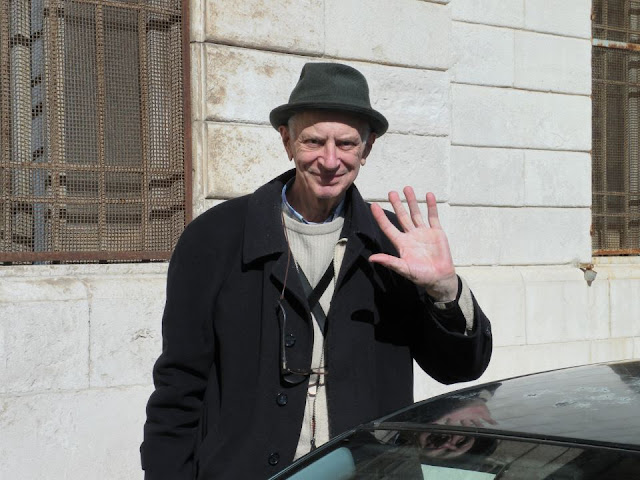
"When Art Meets the Courtroom: Giovanni Gasparro and the cages of creative freedom" by Carlo Coppola

The Giovanni Gasparro Case and the Unresolved Tension Between Art, Faith, and Law
The Bari prosecutor's request for a one-year-and-four-month prison sentence against painter Giovanni Gasparro has reignited a fundamental and deeply unsettling question: where does artistic freedom end, and where does incitement to hatred begin?
The Controversy
The charges stem from a painting depicting Saint Simon of Trent (Simone Unverdorben), whose cult the Catholic Church officially suppressed in 1965 due to its antisemitic implications. The saint's alleged martyrdom was historically linked to a widely discredited "ritual murder" accusation against Jews. According to the prosecution, Gasparro's representation of this iconographic theme—combined with commentary published on social media—constitutes content offensive to the Jewish faith and amounts to incitement to religious hatred. The painting triggered international controversy and denunciations from Jewish organizations and commentators as a revival of medieval blood-libel imagery.
The issue is so sensitive that neither public opinion nor the judiciary can address it without encountering profound ethical, historical, and symbolic complications.
The Artist and His Work
Gasparro is a mannerist painter in the noblest sense. He consciously revives Caravaggesque chiaroscuro and Baroque pathos, constructing choral scenes cut by raking light and rendering bodies with muscular, uncompromising realism. His works have been exhibited widely: early in his career, he held a solo exhibition in Paris, and his paintings have appeared in major venues including the Venice Biennale, the Grand Palais, and galleries across Europe and the United States.
Among his most notable international commissions is the official portrait of His Majesty King Felipe VI of Spain, unveiled in 2021 and now housed in the Reale Pontificia Basilica di San Giacomo degli Spagnoli in Naples—a rare honor for a contemporary painter and a clear marker of recognition at the highest cultural level.
Each canvas tells a story: martyrdoms, saints, ecstasies, and torments—subjects that unsettle those who prefer more palatable contemporary art, including sectors of the Church itself, which increasingly avoids controversy by sidestepping the blood of martyrs and anything capable of provoking spiritual or moral upheaval.
Artistic Vision and Theological Context
At the core of Gasparro's poetic vision lies the body—in agony, in martyrdom, and in glory. These are themes deeply rooted in Christian tradition. As in the Roman Martyrology, pain is rendered with uncompromising tangibility: lacerated skin, taut muscles, flowing blood, severed limbs reminiscent of carcasses in Palermo's markets. Yet Gasparro moves beyond mere horror. Through Baroque lighting, suffering achieves a salvific epiphany: light becomes a restorative force, transforming the drama of flesh into epic narrative. This is not gratuitous morbidity but a deliberate challenge to the anesthetized passivity of much contemporary visual culture, restoring to faith its heroic and tragic dimension.
The Historical Precedent
To condemn Gasparro for depicting historical or religious themes risks establishing a dangerous precedent. Art has always portrayed violence and martyrdom: from medieval Triumphs of Death to Renaissance crucifixions, from seventeenth-century sacred dramas to the visceral representations of both sacred and profane bodies. Gasparro situates himself within this iconographic continuity, reaffirming art's perennial duty to disturb complacency and awaken conscience. Censorship—especially ideological censorship—reduces art to mere decoration. But why does it arise? What are its ideological motivations? And would condemning Gasparro amount, in principle, to posthumously indicting Michelangelo or Bernini?
The Legal Argument
Judicial authorities insist they are not challenging the right to depict violence, nor artistic freedom as such, but rather the context of dissemination. Certain images, when accompanied by explicit commentary, are said to transcend the artistic sphere and take on a propagandistic character, potentially harmful to specific religious communities. From this perspective, the charge is not censorship but protection against religious hatred.
International Reception
Internationally, the Gasparro controversy has become a case study in debates about historical memory and artistic responsibility. Major Jewish advocacy groups publicly criticized the blood-libel depiction as historically inaccurate and antisemitic, arguing that reviving medieval slanders through art carries real-world consequences.
In the Armenian context, while Gasparro's work has not been the subject of prominent museum exhibitions or institutional endorsement, international debates around imagery, memory, and hate resonate with Armenian discourse. Armenia's own cultural institutions, such as the Cafesjian Center for the Arts and the Near East Art Museum in Yerevan, regularly engage with exhibitions that highlight artists' responsibilities in representing historical trauma and ethnic-religious identity. Although there is no major documented Armenian institutional reception of Gasparro's work to date, critical discussions in neighboring art circles often reference the broader European debates about how visual art engages with contested histories—indicating a cautious Armenian awareness of the issues his case raises.
The Central Dilemma
The Gasparro case forces us to confront the uneasy relationship between art, limits, and social responsibility. Must a free society tolerate every artistic expression, even when it is disturbing, offensive, or historically toxic? Or do boundaries exist when art conveys messages that risk reinforcing hatred? The answer is anything but simple. The line separating art from propaganda, provocation from incitement, remains one of the most intricate dilemmas of our time.
And yet, as opera reminds us, whoever plays Cavaradossi must never forget that Scarpia is always lurking nearby.
Conclusion
Whatever the outcome of the trial, one fact is undeniable: Giovanni Gasparro's work—through its figurative intensity, his internationally recognized achievements, and the controversies it evokes—forces us to confront uncomfortable truths. It strikes at the heart of contemporary debates on expressive freedom, the intellectual's ethical responsibility, and the enduring, destabilizing power of images.
Carlo Coppola