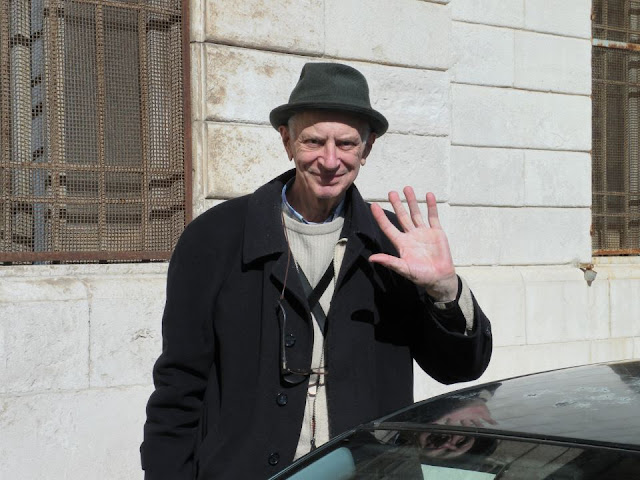
"Mansurian's Purgatorio, with contribution from Grigor Ghazaryan: to Be Performed in Yerevan and in Ravenna Festival" by Carlo Coppola

Mansurian's Purgatorio, with Linguistic Contribution from Grigor Ghazaryan, to Be Performed in Yerevan and at the Ravenna Festival
The Chamber Choir of the Republic of Armenia has been invited to perform at the Ravenna Festival, where it will appear together with the "Luigi Cherubini" Youth Orchestra on the occasion of the 700th anniversary of the death of Dante Alighieri — an anniversary which, owing to the regrettable inattention of some Armenian media outlets, continues to be mistakenly placed within the Italian Renaissance, rather than correctly situated at the dawn of the fourteenth century, in the late Middle Ages.
Two major events will mark this collaboration between Armenia and the XXXII edition of the Ravenna Festival, significantly titled "Dedicato a Dante" ("Dedicated to Dante"). The first, in chronological order, will take place on Sunday, 4 July 2021, in Yerevan, when the Armenian Choir will join the Cherubini Orchestra under the direction of Maestro Riccardo Muti for the concert "Le vie dell'Amicizia" ("The Roads of Friendship") — a musical pilgrimage returning to the Armenian capital twenty years after Muti's historic 2001 tour, when he led the La Scala choir and orchestra there. It is on that same day in Yerevan that the world premiere of Mansurian's Purgatorio will take place. The concert will then be presented in Italy, with a partly different programme, on Thursday, 1 July, at the Pavaglione in Lugo, featuring works by great European composers such as Haydn, Mozart, and Schubert.
The Italian premiere of Purgatorio is scheduled for Sunday, 12 September, when Muti and the Cherubini Orchestra will be joined by the Choir of the Maggio Musicale Fiorentino for the solemn concert closing the national celebrations for the Dante centenary; after Ravenna, the same concert will travel to Florence and Verona, uniting under the sign of music the three cities most closely tied to the supreme poet.
Mansurian's Purgatorio is not an isolated work, but one third of a triptych of new commissions through which the Festival invited three living composers to confront, each in turn, one canticle of the Divine Comedy: to Giovanni Sollima was entrusted the Inferno, with his Sei studi sull'Inferno di Dante, performed at the Rocca Brancaleone; to Valentin Silvestrov, the Paradiso, with O luce etterna, performed by the Kyiv Chamber Choir in the Basilica of Sant'Apollinare in Classe; to Tigran Mansurian — the most important living composer of Armenia — the intermediate canticle, that of Purgatory itself.
Today, 24 June — the day on which the Armenian Church commemorates the Holy Translators, and the Latin Church celebrates Saint John the Baptist — open rehearsals of the choir were held at the Komitas Chamber Music House in Yerevan, attended by journalists. Alongside Maestro Mansurian, conductors Robert Mlkeyan and Armen Arabian also took part.
Speaking about Dante, Mansurian recalled the universal significance of the Florentine poet's work. He explained that the artistic direction of the Ravenna Festival had selected three composers, entrusting each with setting one canticle of the Divine Comedy to music. He added that the work had originally been conceived for a large symphony orchestra, but that, owing to the pandemic, the number of musicians had to be reduced. Mansurian nonetheless preserved the original version, in the hope that it may one day be performed by a full orchestra, while also preparing an adaptation for a smaller ensemble.
The composer acknowledged the considerable difficulties posed by the Italian text. He was assisted by Grigor Ghazaryan, Professor of Italian Language at Yerevan State University and a distinguished specialist in the field, who worked closely with him throughout the process. As the Hrand Nazariantz Study Centre, we are especially proud that Professor Ghazaryan — a long-standing friend and collaborator of ours — was able to clarify for one of the greatest living composers not merely the literal meaning of each word, but also the nuances, rhythm, and expressive accents underlying Dante's thought and poetry.
Fundamental, too, was the organisational contribution of Minas Lourian, Director of the Centre for Armenian Culture Studies and Documentation in Venice, the true architect behind the entire undertaking: it was Lourian who, working closely with the Festival's artistic direction under Franco Masotti, proposed and coordinated the commission entrusted to Mansurian, within a long tradition of Italian-Armenian collaboration rooted in the historic Roman and Byzantine ties between Ravenna and the city's ancient Armenian community.
Finally, Maestro Armen Arabian considered it important to stress that the Italian side covered all expenses related to the choir's participation in the Festival.
Carlo Coppola