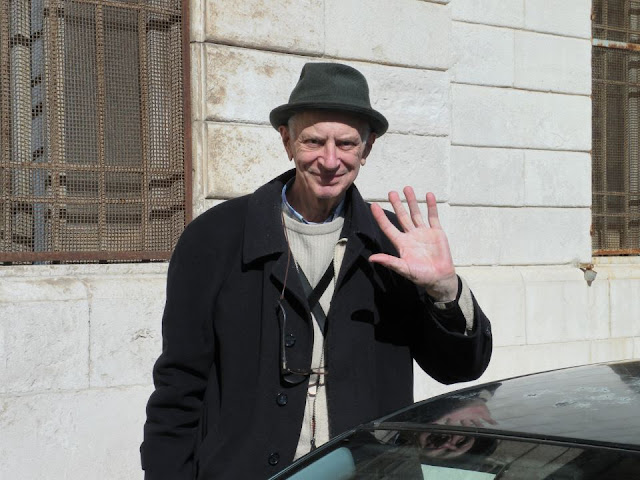
"The Fourth Voice of the Arslan Name: In Memory of Ermanno A. Arslan" by Carlo Coppola

Addio al prof. Ermanno Arslan, un linceo italo-armeno da non dimenticare. Articolo di Carlo Coppola su "In Città Giovinazzo" diretto da prof Antonio Calisi:
Between 31 May and 1 June 2026, Italy and Armenia lost Ermanno Alessio Arslan — historian, numismatist, and archaeologist of international renown — who passed away at the age of eighty-five, a member of the prestigious Accademia Nazionale dei Lincei.
The news will reach many accompanied by the echo of an illustrious surname — a surname that the Armenian diaspora in Italy has declined into at least three distinct vocations, with a consistency that owes nothing to chance and everything to character. Ermanno's father, Yetwart — known as Wart, or Edoardo — Arslan, was a prominent art historian, professor, and scholar who left a lasting mark on Italian art historiography. His brother, the physician Michele Arslan, was among the founding figures of Italian otorhinolaryngology. And it is from Michele that Antonia Arslan descends — thus Ermanno's cousin — the writer whose novel La masseria delle allodole, a finalist for the Premio Campiello, winner of the Premio Strega, and later brought to the screen by the Taviani brothers, succeeded in transforming family grief into universal narrative, bringing the Armenian Genocide into Italian homes with the force of a testimony transfused into literature.
But Ermanno had arrived at history before all of them — not with a novelist's pen, but with the patient rigour of a scientist who interrogates the mute matter of coins and stones, and who in that rare language knows how to say things that others cannot even begin to intuit.
Conservator of the Civic Numismatic Collections of Milan from 1973, Director from 1975 to 2003, Superintendent of the Castello Sforzesco from 1999 to 2005, Professor Ermanno Arslan built an institutional trajectory that would have been sufficient on its own to define an exemplary career. The true measure of this man, however, lay in his scholarly output: a specialist in Greco-Roman, barbarian, and Lombard coinage, Corresponding Fellow of the Accademia dei Lincei from 2003 and National Fellow from 2017, member of the Scientific Council of the Italian Centre for Early Medieval Studies from 1998, he devoted over sixty years of research to archaeology and numismatics, leaving a mark that future generations will struggle to equal. The Mayor of Vibo Valentia — a city that had conferred honorary citizenship upon him in recognition of the historic excavation campaigns he conducted there, including the discovery of the celebrated Orphic Gold Tablet of Hipponion — remembered him as "an absolute giant of archaeology and numismatics." We can only concur entirely with this assessment which, offered today on the occasion of his death, risks appearing a funeral eulogy when it was, and remains, simply the truth.
The Arslan name belongs to Armenia with threefold distinction: the historiographical, that of Wart, who brought to Italian universities the methodological rigour of a family unaccustomed to squandering its talents; the medical and scientific, that of Michele, who applied that same rigour to clinical practice; and the literary, that of Antonia, who within that same family preserves its most searing memory. Ermanno adds to this triptych a fourth voice — the numismatic and archaeological — one that engaged with Armenian civilisation through ancient and medieval coinage, establishing extraordinary connections between the Eastern Christian world and the Lombard West. Four approaches that do not exclude but complement one another: different keys to open the same door, too often ignored or reduced to the sole dimension of a people's martyrdom.
The Honorary Consul of the Republic of Armenia in Bari, Dario Rupen Timurian, upon learning of the passing of the distinguished academician, expressed his heartfelt condolences. The present writer — working in the field of Armenian Memory as Ambassador for Apulia appointed by the Armenian Genocide Museum-Institute in Yerevan, and as Counsellor for General Affairs of the Honorary Consul of the Republic of Armenia in Bari — feels duty-bound to reaffirm publicly how much the Arslan family as a whole has restored to Armenia a plural dignity, beginning from a diaspora too little studied: the Italian one.
To his wife, Professor Agnes Bencze of the Pázmány Péter Catholic University in Budapest — herself a scholar of classical archaeology of internationally recognised distinction, who shared with her husband not only life itself but a passion for the sites and territories of material memory — and to the entire Arslan family, the most heartfelt condolences of all those who have understood, also thanks to him, how much Italy owes to Armenia.
Carlo Coppola